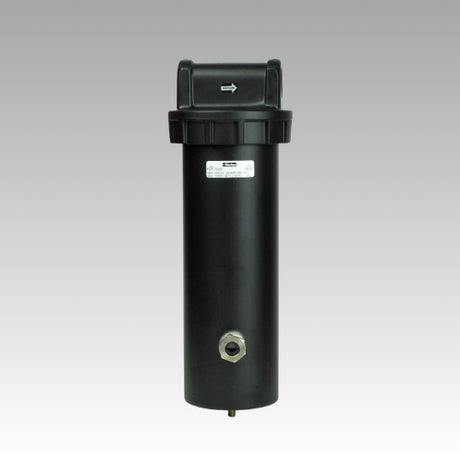
| HOW DO THEY WORK?
As the wet compressed air flows through the inlet port and down
the bed of desiccant, the desiccant (silica gel) beads absorb
the water vapor and aerosols. The silica gel beads are so
effective in absorption the air humidity can be reduced down to
a -40° F pressure dew point. Unless your compressed
air is exposed to a temperature below the due point, there will
be no further condensation forming in your air lines.
The microscopic pores of each silica gel bead are structured
to attract and hold large capacities of moisture and prevent it
from traveling downstream.
After the moisture has been removed, the dry air passes through
a sintered bronze element, up the center tube, and out the outlet
port. As long as the desiccant is replaced regularly, your
equipment will receive ultra dry, moisture-free air.
As the desiccant becomes saturated with moisture, the dew point
will begin to rise. This is evident when the blue silica
gel desiccant beads in the sights glass change to pink, indicating
the need for desiccant replacement. Simply remove the flange and
bowl and replace with new desiccant or regenerate saturated desiccant
by heating to 275°F.
Desiccant dryers are a convenient and cost effective means of
ensuring your sensitive pneumatic applications are never exposed
to damaging moisture. Compact in size, and no external power sources
required, the Watts Fluid-Air desiccant dryers can be used almost
anywhere.
WHY WATTS DESICCANT DRYERS?
Watts Fluid-Air desiccant dryers are the simplest and most reliable
method of insuring your sensitive pneumatic equipment is not exposed
to damaging moisture. When air is compressed, the temperature
of the air is increased as is its capacity to hold moisture.
As the hot moist air travels downstream through the lines, it
cools, allowing the moisture to condense. After coolers,
filters, drain traps, and drip legs are effective for removing
liquid condensate. But for removing residual water vapor
and aerosols, use the Watts Fluid-Air Desiccant Dryer.
PERFORMANCE
The flow capacities in the table are nominal ratings provided
for reference. These capacities are recommended for minimal
pressure drop and average desiccant life.
A supply of low flow/low humidity air will provide longer desiccant
life; where as high flow/high humidity air will require more frequent
desiccant changes.
Installed in an application with intermittent flow, Watts desiccant
dryers will typically dry air for weeks before the silica gel
desiccant requires replacement or regeneration.
RECOMMENDED INSTALLATION
- Always place a moisture separator and/or particulate filter
upstream to remove bulk liquids.
- Always place a coalescing filter upstream to remove oil.
Desiccant coated with oil will not absorb moisture.
- A 5 micron (or smaller) particulate filter is recommend downstream
to remove desiccant dust.
STANDARD FEATURES
- Steel Bowl with Integral Sight Glass
- Zinc Body
- Sintered Bronze Elements DD15 & DD30: 90 µM DD60:
40 µM
- Maximum Operating Temperature: 180° F
- Maximum Working Pressure: 300 PSI
- Optimum Working Temperature: Below 100°
|